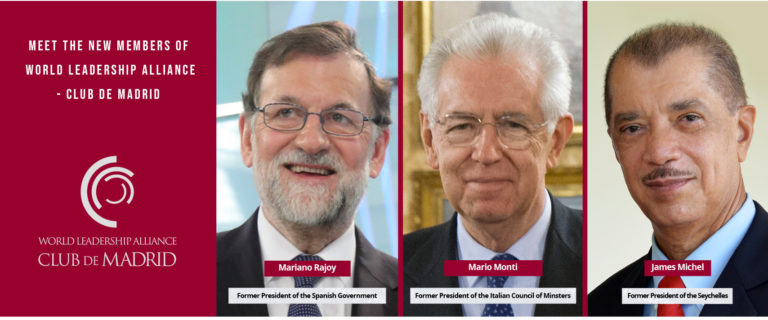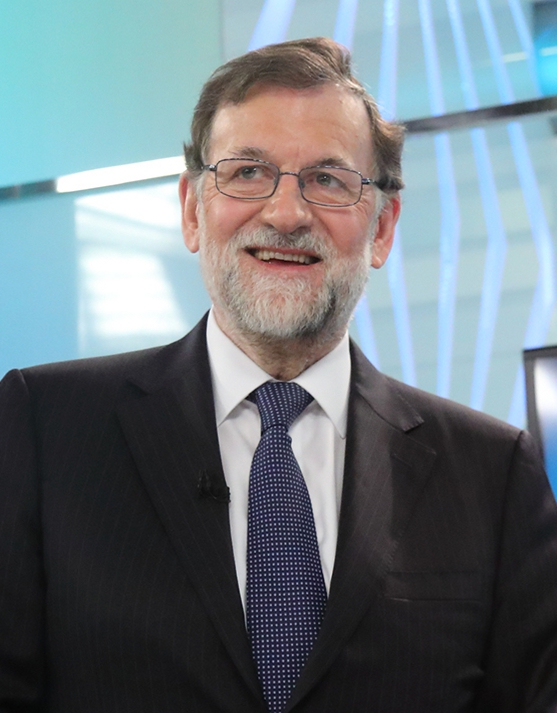
Mariano Rajoy is a former President of Spain (2011 to 2018).
Rajoy studied Law at the University of Santiago de Compostela, in Galicia, where he graduated in 1978.
He began his political career by joining the People’s Alliance (AP), the predecessor of the Popular Party (PP), serving in the regional parliament and, later on, as Vice-President of Galicia’s Regional Government. In 1990, he was named Deputy Secretary General of the PP, a position that gave Rajoy a clear national standing. Afterwards, in 1993, he was reelected to Congress, and from 1996, he served in the PP government of the new Spanish President, José María Aznar (1996-2004), heading the Ministries of Education, Culture, Interior; and as a Vice President between 2001 and 2003. In that year, Rajoy succeeded Aznar as party leader, thus becoming its candidate for the Presidency of the Government in the 2004 and 2008 general elections.
Rajoy achieved Spain’s presidency of the government in 2011, a term marked by the international financial crisis. As a response, he led a major restructuring of the financial system and a labour reform. During his second term, initiated in 2015, Spain’s economy recovered, unemployment fell, and Rajoy oversaw the 2017–18 constitutional crisis detonated by a referendum held in the region of Catalonia.
After leaving office, Mariano Rajoy was reinstated to his position as property registrar in Santa Pola (Alicante), a job he held almost three decades earlier. Later, in April 2019, he became a Full Member of the Club de Madrid (CdM). Additionally, Rajoy is an occasional speaker on the promotion of democracy, Spanish politics and foreign relations.