Climate change is a critical issue for all people’s current and future well-being. We are now at a crucial juncture: we have more and more scientific evidence that we are at risk of destabilising all the global commons on Earth. We know that the impacts are occurring earlier than we had expected. They are hitting harder than we had predicted. The most severe harms from climate change fall disproportionately upon the most vulnerable worldwide. The devastating effects of extreme events, temperature increases, and sea-level rise will worsen with consequences for all of us, particularly the poor. As the most recent IPCC report warned us, we have to act now: “taking action now can secure our future”.
Through the Paris Agreement, nearly all countries committed to reducing greenhouse gas emissions and limiting global warming to preferably 1.5 degrees. Industrialised nations have responsibility for climate change; they have a high per capita emission, so they have to take the lead. At the same time, greenhouse gas emissions in emerging economies are rising rapidly; these countries already account for two-thirds of global emissions. Nationally determined contributions (NDCs) are at the heart of the Paris Agreement and the achieving its long-term goals. NDCs embody efforts by each country to reduce national emissions and adapt to the impacts of climate change. Measures for climate change mitigation and adaptation create new opportunities for innovation, employment and sustainable prosperity. We need to change the climate narrative to see adaptation as a driver to undertake activities with multiple benefits that can catalyse progress in achieving a country’s sustainable development goals.
Climate change is also one of the most critical challenges our democracies face. The inherent ‘short-termism’ of democratic decision-making and the constraints imposed by the confines of decisions, policies, and measures at a national level have, however, seriously affected progress on the climate change front, despite the lofty commitments made at the multilateral level.
Our continued reliance on fossil fuels makes the global economy and energy security vulnerable to geopolitical shocks and crises but we must accelerate the energy transition to renewables for the sake of our future and our security, as the Russia – Ukraine war is painfully evidencing right now. We know that this transition will require the adoption of far-ranging policies that will surely require significant adjustments in social organization modes and lifestyles all around the world. In democratic systems, however, the broad range of possibilities for policy action to achieve this transition must be broadly supported and accompanied by the majority, even the vast majority, of their societies – governments, citizens, media, business leaders, the productive sectors and many others.
Science tells us we still have time; are we willing to make it happen?
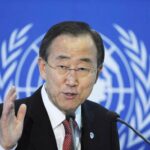
Club de Madrid Honorary Member and former UN Secretary-General (2007-2016) Ban Ki-moon will participate in “Climate Proofing the Future: Adaptation, Decarbonisation, and Development”, a high-level dialogue with the Spanish Deputy Prime Minister for Ecological Transition, Teresa Ribera, and the co-president of the Club of Rome, Sandrine Dixson-Declève.
The conversation took place on the 23rd of June 2022. Watch it here:
English

Spanish

Speakers
- Ban Ki-moon, UN Secretary-General (2007-2016) and Honorary Member of Club de Madrid.
- Teresa Ribera, Deputy Prime Minister of the Government of Spain for Ecological Transition.
With the participation of Sandrine Dixson-Declève, Co-President of the Club of Rome.
Moderated by Cristina Manzano, Constituent Member of Club de Madrid.