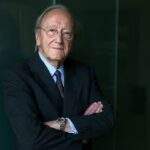
Steve Killelea, founder and Executive Chairman of the Institute for Economics and Peace (IEP) presented the new version of the GPI during an event titled “Cultivating sustainable peace: the Global Peace Index” held on May, 26th in Brussels in the headquarters of the European Policy Center.
The Secretary General was joined by Kinga Göncz, Member of European Parliament (S&D, Hungary) and Member of the Network of Political Leaders United to Support Shared Societies (NetPLUSS). They had the opportunity to discuss the results of the 2011 Global Peace index (GPI), recently released. The GPI, produced by the Institute for Economics and Peace (IEP), is the world’s leading measure of global peacefulness. It gauges ongoing domestic and international conflict, safety and security in society, and militarisation in 153 countries by taking into account 23 separate indicators.
Mr. Westendorp and Ms. Göncz explained the Club de Madrid work on the Shared Societies Project with the issue of overcoming social division and to what extent this is linked to the work of the IEP on the Global Peace Index. The latter manages to explain how the environments that shape peace are also the same environments that create the appropriate conditions for social sustainability. The Club de Madrid Shared Societies Project supports that within a world increasingly diverse and conscious of social and political inequalities, the question of how we live together and how we manage our differences is one of the most important conversations of our time. So, to live in peace, said Mr. Westendorp “we need to learn how to live together”.
Mr. Killelea explained that if the world had been 25% more peaceful over the past year there would have been an economic impact of US$2 trillion to the global economy. He remarked that “There is increasing recognition that there is a real ‘peace dividend’ to be had. Our research identifies eight social attitudes and structures required to create peaceful, resilient and socially sustainable societies.”
The 8 structures are: Well-functioning government; Sound business environment; Equitable distribution of resources; Acceptance of the rights of others; Good relations with neighbours; Free flow of information; High levels of education; Low levels of corruption.
The IEP is an international research institute dedicated to building a greater understanding of the inter-relationships between business, peace and economics with particular emphasis on the economic benefits of peace.