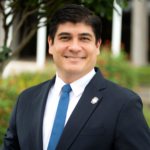
Guatemala, February 12, 2026.- Club de Madrid and the Institute for Climate, Democracy and Inclusion (CDI) have just concluded a mission in Guatemala led by three Members of the Club de Madrid: former President of Costa Rica Carlos Alvarado Quesada, former Prime Ministers Kjell Magne Bondevik of Norway and Stefan Löfven of Sweden.
Between February 9 and 11, 2026, and in dialogue with various key actors of Guatemalan society, this high-level delegation focused on observing and accompanying the processes for the selection and appointment of authorities in three key bodies for Democracy and the Rule of Law in Guatemala – the Supreme Electoral Tribunal, the Constitutional Court, and the Public Prosecutor’s Office.
During its visit, the delegation held meetings with President Bernardo Arévalo, political, judicial, and electoral authorities, representatives of the international community, civil society, ancestral Indigenous authorities, journalists and human rights defenders, as well as private-sector and academic actors. Among the most significant meetings were visits to Indigenous leaders Héctor Chaclán and Luis Pacheco, as well as journalist José Rubén Zamora, who remain in prolonged pretrial detention at the Mariscal Zavala Penitentiary Center.
This broad meeting with different sectors allowed the delegation to listen to and understand the challenges and opportunities regarding the independence, transparency, and integrity of the ongoing second-degree election processes—processes that will appoint the highest authorities of key institutions of the State, Justice, and Guatemalan democracy.
The delegation of Club de Madrid and CDI celebrates the beginning of the election processes of these authorities, where some candidacies have been identified that do have suitable professional profiles and solid track records, though not all, as well as greater citizen interest and engagement by civil society actors, for example from the private sector and religious groups, which reflect a growing awareness of the importance of meritocracy and transparency in strengthening democracy in Guatemala. The delegation has observed with interest these groups’ commitment to participate, monitor, and report on everything related to the ongoing second-degree election process.
The mission hopes that these processes can be carried out with transparency, clarity, and integrity, in line with established norms and seeking to materialize the rule of law that Guatemala built following its peace process.
The delegation considers it fundamental that all candidates nominated for positions of authority have professional profiles suitable to their mandates, and that all those who have been sanctioned or convicted for acts of corruption or human rights violations be discarded. Likewise, these processes should not, under any circumstances, be vehicles to ensure continued judicial immunity.
The delegation has heard with concern examples of intimidation and criminalization of key actors during the election process, as well as possible interference by powerful interest groups with links to organized crime within the nominating commissions and electoral bodies. It is necessary to eliminate the influence of these actors, some linked to organized crime networks, in the election processes and in the very configuration of institutions.
Club de Madrid and CDI also express their deep concern about the prolonged detention of people for extraordinary periods without substantive procedural progress. The deprivation of liberty in the cases known to the delegation appears to lack sufficient legal justification, constituting a serious impairment of fundamental rights such as freedom of expression and association. Civil society expressed its concern about a tendency to charge people with sedition or terrorism for acts that clearly do not correspond to that figure.
Recent statements by the United Nations High Commissioner for Human Rights and the Organization of American States (OAS) coincide in noting that the cases observed show indications of a possible criminalization of legitimate activities in a democratic environment—activities recognized as such by international standards regarding respect for fundamental rights.
Club de Madrid and CDI urge full respect for due process and judicial guarantees, and call for an urgent review of these cases, including the release of people whose detention is not duly substantiated in accordance with international standards and Guatemalan law. The mission notes the existence of dialogue processes among different sectors, including civil society organizations, universities, the private sector, and ancestral Indigenous authorities, and, as one of its central recommendations, underscores the importance of maintaining them as a key element to strengthen democracy and accountability. The delegation calls on citizens and their organizations to remain vigilant during the development of these processes.
Club de Madrid and CDI reaffirm their commitment to Guatemala, and their willingness to continue supporting efforts that protect human rights, strengthen the rule of law, and promote solid, inclusive, and independent democratic processes, fundamental pillars for democratic stability and public trust. They reiterate their availability and interest in returning to the country to continue accompanying and observing these important processes.
About Club de Madrid:
Club de Madrid is the world’s largest forum of democratic former Presidents and Prime Ministers, who leverage their individual and collective leadership experience and global reach to strengthen inclusive democratic practice and improve the well-being of people around the world.
As a non-partisan and international non-profit organisation, Club de Madrid counts on the hands-on governance experience of more than 130 Members from over 70 countries, along with a global network of advisers and partners across all sectors of society.
This unique alliance stimulates dialogue, builds bridges and engages in advocacy efforts to strengthen public policies and effective leadership through recommendations that tackle challenges such as inclusion, sustainable development and peace, at the national and international levels.
www.clubmadrid.org
About CDI Institute:
The Institute for Climate, Democracy and Inclusion (CDI) is a non-partisan organization that promotes freer, more prosperous, and more inclusive democracies, as well as climate action for this generation and future generations..
CDI is chaired by former President of Costa Rica Carlos Alvarado Quesada (2018–2022), and brings together experts with extensive experience and a deep commitment to strengthening democratic values and social inclusion, as well as protecting the planet.
The values of CDI are democracy, sustainability, inclusion, rigorous thinking and action, and high ambition in the objectives.