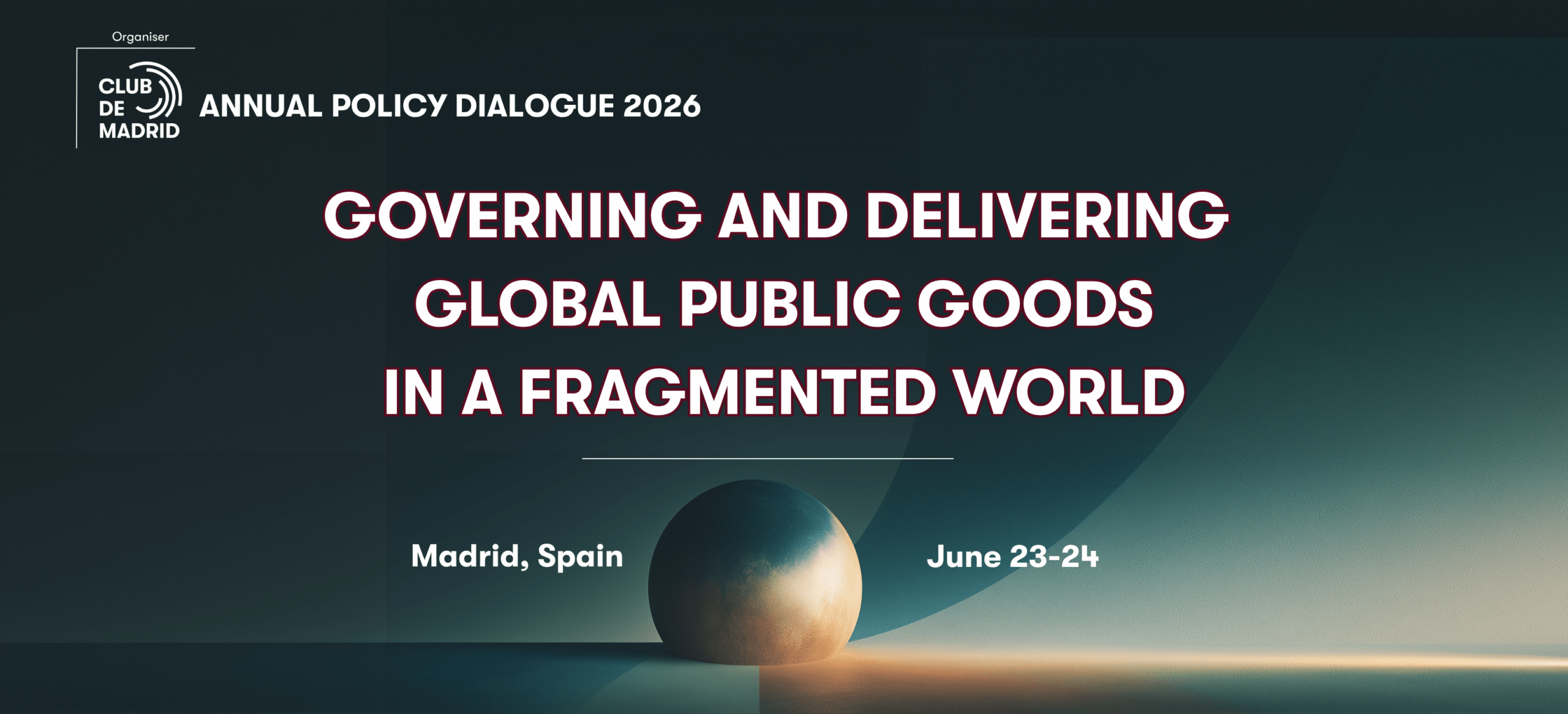
Annual Policy Dialogue on Governing and Delivering
Global Public Goods in a Fragmented World
23 – 24 | June 2026
Madrid, Spain

The past few years have been marked by profound disruption, reshaping the frameworks that once sustained international cooperation. As the world navigates the decline of the post-war order, deepening geopolitical divides, and the accelerating climate crisis, it is clear that we are entering a new era — one in which the governance of what is essential for humanity and the planet can no longer rely on inherited systems.
Club de Madrid’s Annual Policy Dialogue 2026, “Governing and Delivering Global Public Goods in a Fragmented World,” takes place at a defining moment for global governance. Today’s fragmentation challenges the capacity of multilateral institutions to respond to shared risks — from climate instability and global health to digital governance and economic resilience. Yet, within this uncertainty lies an opportunity: to reimagine how we govern our interdependence and renew the foundations of cooperation.
Through its convening power and unique network of over 130 democratic former Heads of State and Government, Club de Madrid provides an unparalleled platform to bridge divides, generate trust, and advance pragmatic solutions. Its Members’ leadership experience — spanning transitions, reforms and crises — equips them to foster dialogue that transcends geopolitical, ideological and generational boundaries.
The 2026 Policy Dialogue will mobilise this collective leadership to develop actionable proposals around three key dimensions:
· Reimagining global governance frameworks for the effective provision of Global Public Goods.
· Embedding democracy as a practical infrastructure of legitimacy, accountability and cooperation.
· Designing a future-oriented financing model, based on shared investment and long-term stewardship, capable of delivering these goods at scale.
These discussions will unfold through a multi-phase process culminating in a High-Level Meeting in Madrid in June 2026, gathering Members of Club de Madrid, experts, and leaders from governments, multilateral institutions, civil society, and the private sector. Together, they will shape a coherent vision for governing global public goods in an increasingly fragmented world — one grounded in democratic values, inclusive participation, and collective responsibility.
The insights and recommendations arising from this Dialogue will inform key decision-making arenas, including the implementation of the Pact for the Future, COP31, the reform of the international financial architecture, and the broader agenda for global cooperation beyond 2030.
In an age of fragmentation and mistrust, the 2026 Annual Policy Dialogue stands as a call for renewed multilateralism — one that restores legitimacy, redefines shared purpose, and strengthens democracy as the foundation for governing what binds humanity together: our global public goods.
Working Group 1
Led by Francesco Saraceno, Deputy Department Director at OFCE-Sciences Po, in close coordination with George Papandreou, Prime Minister of Greece (2009-2011) and Club de Madrid Member
This Working Group focuses on the governance conditions required for the effective provision of global public goods in a context of geopolitical fragmentation and declining trust in institutions. It examines how cooperation can be rebuilt by strengthening legitimacy, accountability and participation across global, regional and national levels, and by adapting governance arrangements to contemporary power dynamics and multi-actor realities. The group’s work provides the institutional and political foundation against which financing choices and delivery models for global public goods are shaped and assessed.
Working Group 2
Led by Simon Reid-Henry, Co-Founder of the Global Public Investment Network
This Working Group concentrates on the financial structures that enable or constrain the provision of global public goods at scale. It explores how financing models influence incentives, responsibility-sharing and long term sustainability, and how existing financial architectures can be adapted to move beyond traditional donor–recipient approaches. The group’s work complements the governance focus of Working Group 1 by analysing how financial arrangements can reinforce legitimacy, accountability and collective action in support of effective delivery.
Case Studies
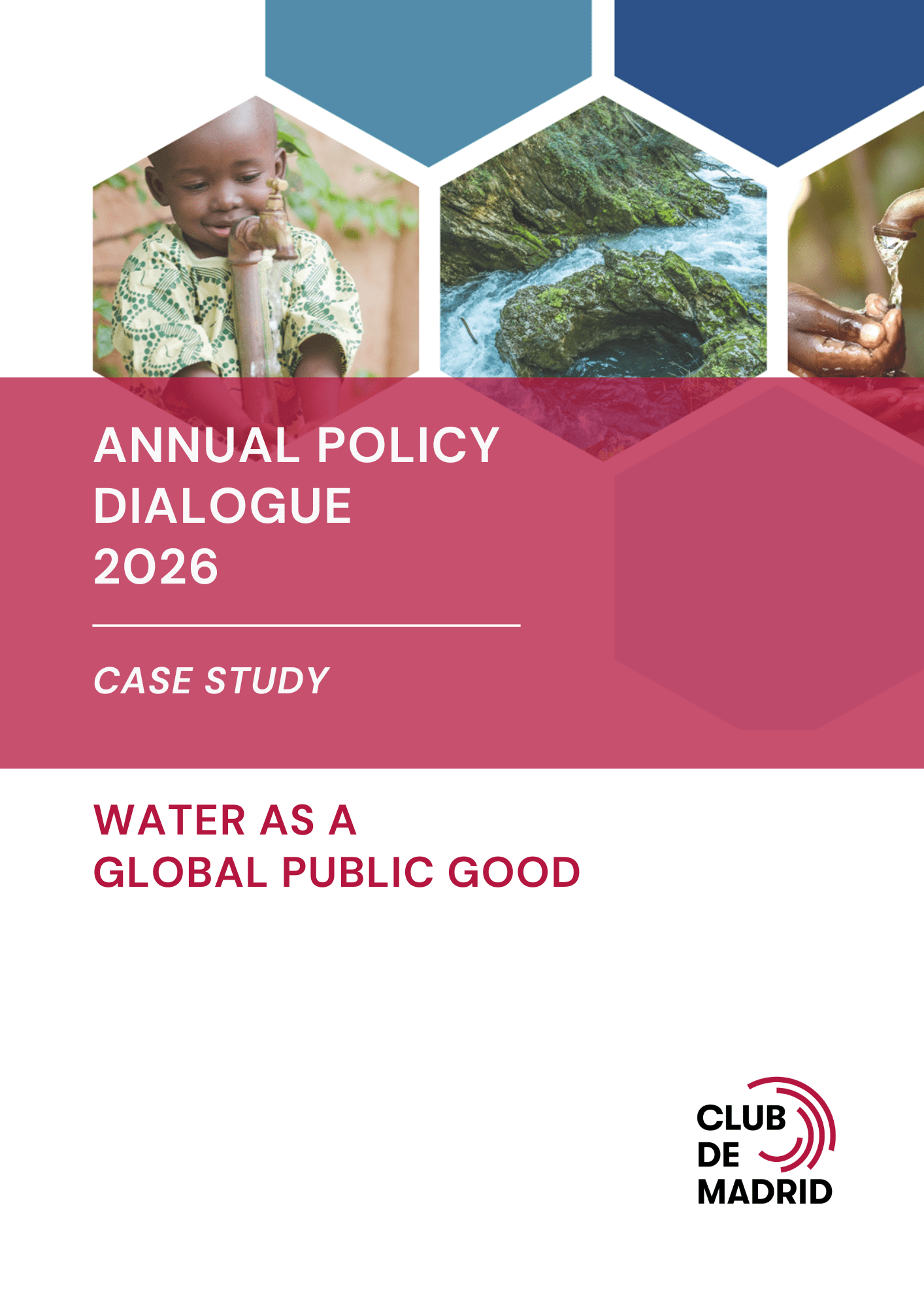
Water as a Global Public Good
Annual Policy Dialogue 2026
The 2026 Case Study “Water as a Global Public Good” examines water security as a critical global challenge that extends beyond issues of scarcity, infrastructure, and finance to encompass governance, accountability, and international cooperation. It argues that while water itself is not a pure global public good, the systems that support water security—such as monitoring, data sharing, transboundary cooperation, pollution control, and climate-resilient planning—generate shared benefits across communities, countries, and generations. Using water as a practical test case, the paper proposes a functional approach to governing and financing these public-good functions, strengthening existing institutions and ensuring that global commitments translate into safe, affordable, and reliable water services for all.
Governing Digital Public Goods
Annual Policy Dialogue 2026
The 2026 Case Study “Governance of Global Digital Public Goods for Digital Public Goods for Digital Public Infrastructure” examines the governance of digital public goods and digital public infrastructure as a central challenge for democracy, sovereignty, development, and international cooperation. Data—not openness or technical standards alone—is the foundational public good of the digital economy, while interoperability and open standards are governance mechanisms needed to prevent its private enclosure and concentration in dominant technology platforms. The paper proposes moving beyond technical, stack-based solutions toward democratically accountable institutions that build trust, protect rights, strengthen sovereign agency, and ensure sustainable public financing. Regional approaches, particularly shared infrastructure, policy frameworks, and regulatory capacity in the Global South, may offer the most viable pathway for translating digital public goods into inclusive public value and resilient public services.
Global Public Health as a Global Public Good
Annual Policy Dialogue 2026
The 2026 Case Study “Global Public Health as a Global Public Good” examines the growing gap between global health commitments and health outcomes, highlighting how the COVID-19 pandemic, vaccine inequities, institutional mistrust, and fragmented governance have exposed weaknesses in coordination, financing, and accountability. It proposes a pragmatic, multi-level approach to global health governance that strengthens regional institutions, aligns financing with public goods provision, and fosters greater accountability. Through a focus on maternal, newborn, and child health indicators, the paper argues for moving from rhetorical solidarity to operational solidarity, ensuring that global public health is governed as a shared responsibility and delivered as sustained public value.