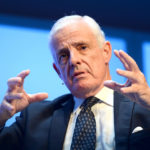
The Roundtable was held in partnership with Edelman, a Public Relations and Marketing firm that publishes a Trust Barometer yearly. Their analysis about citizens’ trust in democratic institutions served as a starting point of a conversation that also delved into Club de Madrid’s work in information integrity and the future of democracy.
Only one in five citizens feel that “the system is working for them”, finds Edelman’s Trust Barometer. This is a standard refrain of swing voters and people who feel alienated and is perceived both in the right (with the rise of exclusionary nationalism) and in the left (with a staunch increase in protest movements, like the ‘Yellow Vests’).
Participants at the ‘Trust and Democracy’ Roundtable considered these phenomena a failure of politics. Without neglecting the structural issues behind them -economic inequality, abandonment of the losers of globalization…- participants at the roundtable agreed that the online information ecosystem is also having a profound effect on how people perceive politics.
Nowadays news engagement is greater than ever and yet citizens express sound distrust over media, the Trust Barometer finds. While citizens trust traditional media more, many still get their news online. Anonymousness, zero-cost publishing, together with content algorithms have created echo chambers that push online citizens into ideological one-sidedness favour the propagation of distorted or malign political messages, including fake news, hate speech, extremist and polarizing ideas. These distortions are inherent to the business model of online platforms.
Furthermore, when targeted advertizing is added to the mix the playing field between opaque actors that seek to influence elections and democratic institutions that have an online presence is unleveled, as the Cambridge Analytica scandal shows. Target advertising allows these opaque actors to easily identify the audience most likely to take action on their behalf. Brexit and the 2016 US elections are only some examples of events where political actors have fulfilled their agendas by using disinformation, bots or work-puppet accounts.
Do we need to learn to live in a low-trust world? Or can we find a solution to protect information integrity online and focus on addressing the structural drivers behind declining trust in institutions, like economic inequality?
Calls for regulating online platforms are increasing. A participant pointed out that governments should not retreat from setting standards of freedom of expression in the digital era. This should not bring about censorship, but a better organization of the current political dialogue.
Members of CdM joined the calls for regulating the online information environment since we are “constantly playing catch-up” with social media, they observed. A Roundtable held in Riga set the grounds for the organization’s work in this matter, producing an outcome document called Protecting Information Integrity: National and International Policy Options. CdM Members pointed out in the ‘Trust and Democracy’ Roundtable that any institution setting up policy options to regulate online platforms, like Club de Madrid, should follow principles of trust, transparency and accountability.